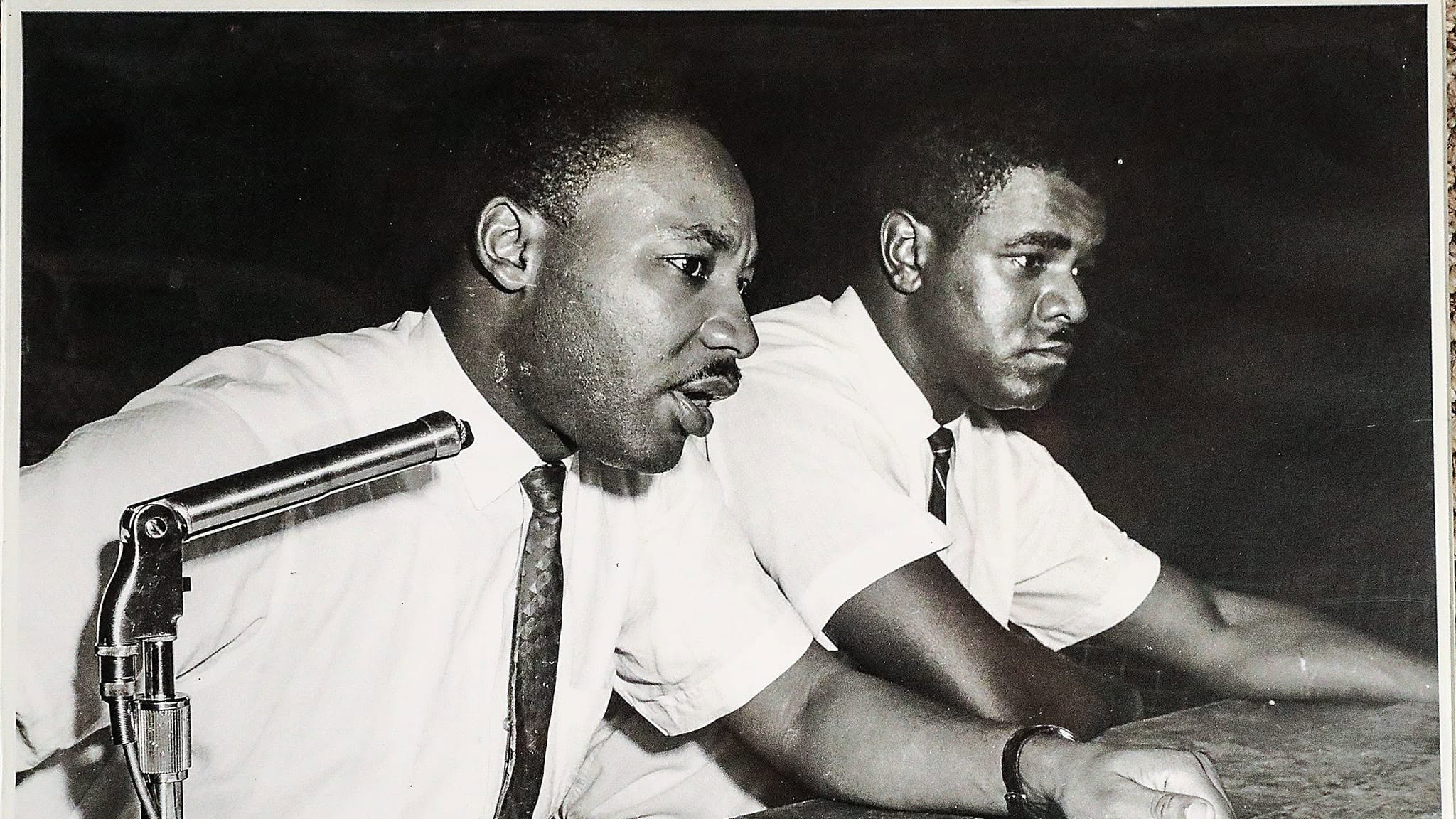
Anderson, the legendary physician and former Albany Movement president who worked alongside Martin Luther King Jr. against Jim Crow, died Sunday at 98
DETROIT, MI, UNITED STATES, August 19, 2026 /EINPresswire.com/ — Nationally acclaimed journalist, author and public intellectual Bankole Thompson, the first journalist in American history to serve on the National Board of Directors of the Southern Christian Leadership Conference (SCLC), the civil rights organization, which laid the groundwork for the 1964 Civil Rights Act and the 1965 Voting Rights Act, and founded by the Rev. Dr. Martin Luther King Jr., has been invited by the family of legendary civil rights leader Dr. William G. Anderson, to deliver a tribute at Anderson’s funeral service on Tuesday, Aug. 25, 11am at Empowerment Church in Southfield, Michigan.
Anderson, 98, died Sunday, Aug. 16, closing an extraordinary chapter in American civil rights, medicine and education.
The invitation to Thompson is both personal and historically fitting.
Thompson spent considerable time with Anderson over the years, listening to and documenting the reflections of a man whose life stretched from an America still living in the shadow of slavery to the modern struggle over the meaning of democracy and equality.
Last year, Thompson devoted his twice-weekly opinion column in The Detroit News to Anderson’s remarkable life and legacy titled, “William G. Anderson’s long walk to freedom.”
Anderson was one of the nation’s remaining direct links to the heroic generation that confronted Jim Crow. As a founder and president of the historic Albany Movement in Georgia, Anderson helped lead one of the seminal campaigns of the modern Civil Rights Movement. He worked alongside Dr. King, Ralph Abernathy and other movement leaders in the struggle against segregation in Albany.
The Albany campaign became an important proving ground for the movement, helping shape lessons about nonviolent resistance, organizing, institutional power and the entrenched nature of segregation that would influence subsequent campaigns across the South.
Only one generation removed from slavery, Anderson’s life encompassed an almost unparalleled sweep of the American experience. He did not merely witness history. He helped make it.
Anderson’s influence extended far beyond the Civil Rights Movement. An osteopathic physician, surgeon, educator and hospital administrator, Anderson built a pioneering career in American medicine while continuing his lifelong advocacy for human dignity and equal opportunity.
He was a founding faculty member of the Michigan State University College of Osteopathic Medicine and became the first African American president of the American Osteopathic Association, breaking one of the significant racial barriers in the osteopathic medical profession.
His professional leadership also included service as president of the Wayne County Osteopathic Medical Association and the Michigan Osteopathic Association. Over the course of his career, Anderson became an influential national figure in osteopathic medicine, medical education and efforts to expand opportunity within the profession.
Michigan State University ultimately attached Anderson’s name to one of its most important civil rights educational traditions, the Dr. William G. Anderson Lecture Series, Slavery to Freedom: An American Odyssey.
The series has brought generations of students and members of the public into conversation with some of the nation’s leading civil rights figures and thinkers, including the late Congressman John Lewis, Harry Belafonte and other major voices of the freedom struggle.
In 2020, Anderson personally called Thompson and asked him to serve as a featured speaker for the prestigious lecture series.
Six years later, Anderson’s family has now asked Thompson to help offer a final public tribute to him.
The invitation is particularly fitting given Thompson’s own body of work interpreting the unfinished meaning of the Civil Rights Movement for contemporary America.
Thompson is a nationally recognized journalist, author, columnist and public intellectual whose body of work has examined democracy, race, poverty, economic inequality, presidential leadership and the moral obligations of institutions for more than two decades.
Before becoming a twice-weekly opinion columnist for The Detroit News, Thompson served for nearly a decade as the longtime editor of the Michigan Chronicle, the historic African American newspaper in Detroit, where he emerged as a significant editorial voice on Black America, urban affairs, presidential politics and civil rights.
During his tenure, Thompson became one of the first Black editors in the nation to conduct a series of exclusive sit-down interviews with former President Barack Obama, chronicling Obama’s historic emergence on the national political stage.
Thompson later became the first journalist in American history to serve on the National Board of Directors of the Southern Christian Leadership Conference. He was nominated to the board in 2023 by his longtime mentor, the late Rev. Dr. Bernard LaFayette Jr., the Freedom Rider, Selma voting rights strategist, close associate of King and one of the architects of the nonviolent movement that produced the Voting Rights Act of 1965.
That distinction gives Thompson’s role at Anderson’s funeral a particular generational significance: a journalist whose work has been shaped by direct relationships with veterans of the King movement has now been asked to help memorialize another of that movement’s historic figures.
In January 2018, the late civil rights leader Rev. Jesse Jackson Sr. personally presented Thompson with the Let Freedom Ring Journalism Award during a ceremony commemorating the 50th anniversary of King’s death, recognizing Thompson’s work as a voice of conscience and courage.
Thompson also received the Frederick Douglass Award in 2014.
His intellectual work has increasingly entered the archival and scholarly record. In 2015, the University of Michigan’s Bentley Historical Library established The Bankole Thompson Papers, preserving his journalistic and public work for future scholars, a rare honor for a living journalist.
Thompson’s 2023 book, Fiery Conscience, an examination of his decades of speaking truth to power on racial and economic justice issues, was reviewed by Forbes and is documented as a reference resource in the Jean Blackwell Hutson Research and Reference Division of the Schomburg Center for Research in Black Culture in New York, one of the nation’s foremost repositories devoted to preserving the history and intellectual traditions of the global Black experience.
Thompson is also founder and chairman of The PuLSE Institute, a national anti-poverty and economic justice think tank and host of the Bankole’s Nation podcast. His latest book, HOPE: On The Mountain Of Fear, examines hope, human dignity, democracy, poverty and the moral responsibility of leadership with a foreword written by Presidential Medal of Freedom Recipient Sister Simone Campbell.
He is currently completing “Bankole Thompson’s 12 Moral Questions: Frederick Douglass and the Soul of America at 250,” a new book examining the American experiment through the moral questions raised by Douglass, Dr. King and other historic voices.
Former federal chief judge Gerald E. Rosen, who served as chief judicial mediator in Detroit’s historic municipal bankruptcy, recently offered a strong endorsement of the forthcoming book after reading portions of the manuscript.
For Thompson, however, the invitation from Anderson’s family transcends professional biography.
“When an elder like Dr. Anderson dies, it is almost as though a museum has disappeared,” Thompson said. “Archives can preserve documents and photographs can preserve faces. But elders preserve the texture of history including the rooms they entered, the fear they confronted, the arguments they witnessed, the sacrifices they made and the courage required when nobody knew how history would turn out.”
Thompson added, “They were willing to sacrifice something of themselves so that people they would never meet could inherit freedoms they themselves had been denied.”
Thompson said Anderson’s death should also force the nation to confront the rapidly disappearing generation of men and women who personally carried the history of the Civil Rights Movement.
For that reason, Thompson said Anderson’s funeral is an opportunity for Detroit and the nation to honor one of the remaining giants of a generation that fundamentally altered the course of American democracy.
Anderson’s funeral will be held Tuesday, Aug. 25, at Empowerment Church in Southfield, Michigan, where Thompson will join Anderson’s family, friends, colleagues and members of the community in paying tribute to his nearly century-long journey.
“The most meaningful tribute we can offer Dr. Anderson is not simply to remember what his generation accomplished, but to ask whether ours possesses the courage to continue the unfinished work they left in our hands,” Thompson said.
BANKOLE THOMPSON
The PuLSE Institute
email us here
Legal Disclaimer:
EIN Presswire provides this news content “as is” without warranty of any kind. We do not accept any responsibility or liability
for the accuracy, content, images, videos, licenses, completeness, legality, or reliability of the information contained in this
article. If you have any complaints or copyright issues related to this article, kindly contact the author above.

Media gallery