NINGBO, ZHEJIANG, CHINA, November 23, 2026 /EINPresswire.com/ — A hot and cold eye massager is worth private labeling when the brand can own something a catalogue model cannot hand over: the identity, the claim wording and the supply chain. The engineering stays with the factory either way. This guide uses the published PR-See1 platform and our published OEM and ODM paths to show which route fits which program, what a credible quotation has to contain, and where the risk actually sits.
By Lingyan Sang|13 Years of Personal Massage Equipment Manufacturing|Ningbo Pinren Electric Appliance Co., Ltd.|November 19, 2026
Key Takeaways
Private labeling is worth it when you own the story, not the hardware. PR-See1 cools the contact pad to 20–25 °C and heats it to 36–40 °C from the same module, which a heating-film pad or a gel pack cannot copy.
Three routes, very different commitments. Flexible branding starts at 200 pieces at 12 to 18 days, ODM customisation from 500 to 1,000 pieces at 15 to 30 days, and full OEM at 2,000 pieces with 60 to 120 days including tooling.
Most of what you buy is identity, not engineering. Logo application starts at 100 pieces, surface branding at 200 to 500, a colour box at 500 and a Pantone colourway at 1,000.
The risk sits in the file, not in the factory. A customised device inherits CE, FCC, RoHS and UKCA only while the change stays inside the certified product family.
Treat it as a staged commitment. Prove demand with 200 branded pieces, fix the identity at 500 to 1,000, change the function at 2,000, and consider a new mould last.
What Are You Actually Buying When You Private Label a Hot and Cold Eye Massager?
You buy three things: the identity, the claim wording and the supply chain. The engineering, the tooling and the test file stay with the manufacturer, and no amount of branding changes that. A brand that thinks it is buying a device is buying a badge and a promise; a brand that thinks it is buying a factory is buying someone else’s tooling.
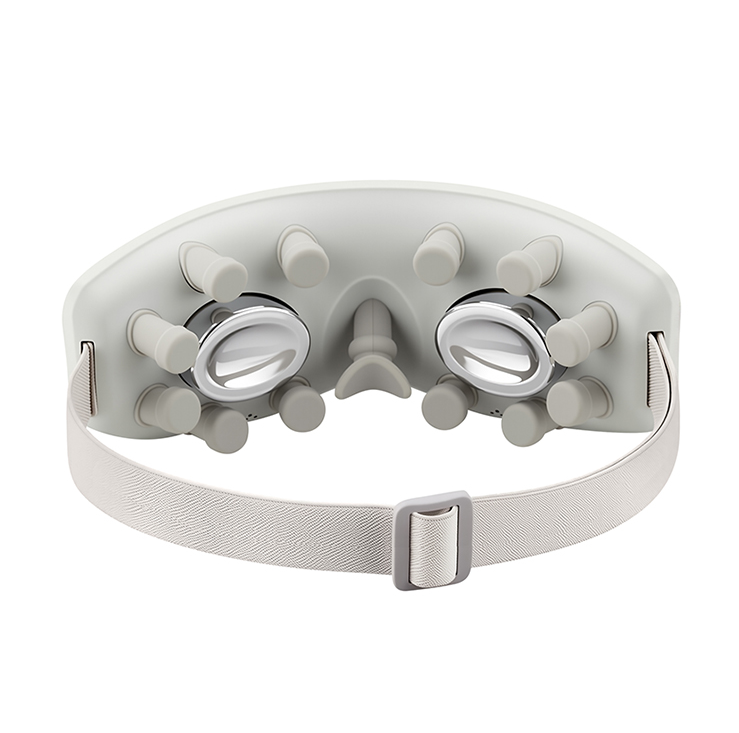
The platform underneath decides what you can say. Our hot and cold eye massager OEM platform uses Peltier semiconductor modules in the contact pads: the same module cools to 20–25 °C or heats to 36–40 °C by reversing the current, switching in under three seconds with no ice pack, gel pack or second device. Around that sit 12 massage nodes driven at up to 12,000 ± 3,000 vibrations per minute, telescopic aluminium eye pads that adapt to different face widths, five massage modes, six temperature settings including a hot and cold cycle, and a 2000 mAh cell.
Private labeling a hot and cold eye massager does not make the engineering yours. It makes the identity, the claim wording and the supply chain yours.
Which Route Fits Your Program: Resale, ODM, or Full OEM?
The route decides the commitment, and the commitment decides the risk. Every path below is published, with the published minimum and timeline, so you can size a program before you ask for a price.
Published customization routes for a private label hot and cold eye massager, with the minimum quantity and timeline for each.
Route What you change Published minimum Published timeline
Flexible branding Peel-off brand sticker, packaging seal, multilingual parameter label 200 pieces 12 to 18 days
Logo application Sticker, label or tag 100 pieces 7 days
Surface branding Laser engraving, silkscreen, pad print, silicone emboss 200 to 500 pieces 10 days
Packaging and colour Custom colour box, Pantone-matched colourway 500 pieces, colourway at 1,000 15 days, colourway 20 days
ODM customisation Structure and materials on an existing platform 500 to 1,000 pieces 15 to 30 days
Full OEM Your specification, structure to materials 2,000 pieces 60 to 120 days including tooling
One rule governs the table: the further you move from the certified product, the more of the file you take on. A sticker changes nothing; a new housing, a new eye pad shape or a different thermal module changes the product in the way an inspector cares about, and we set out where that line sits below.
What Does Private Labeling Actually Buy Your Brand?
Inside view of the PR-See1 platform: 12 vibration nodes placed around the eye contour, telescopic aluminium eye pads on a spring-loaded frame and a silicone nose pad.
Four levers do most of the work, and three cost nothing in engineering time. The first is placement: published logo options cover the top cover, the side strap, the charging port cover and the colour box, applied by laser engraving, silkscreen, pad print or silicone embossing.
The second is the pack: colour box artwork, multilingual manuals in EN, DE, FR, IT, ES, JA, KR and JP, warranty cards and custom inner trays, with packaging tooling at 7 to 10 days from artwork sign-off.
The third is firmware, where a brand quietly becomes hard to copy. The published list covers the voice guidance language pack, the default mode, the default temperature, the idle timeout, the beep tones and the Bluetooth device name, so a paired device carries your name in the user’s phone.
The fourth lever is fit. The telescopic aluminium pad system adapts to eye contours and face widths, and custom frame ranges are available for markets with different average face anthropometry, so an Asian or European fit is developed with new mould development rather than an import warning.
The cheapest differentiation is the one buyers notice first. The most valuable is the one nobody copies: your name on the box, your language pack on the voice prompt, your name in the Bluetooth pairing list.
Where the Risk Sits: Certification, Battery Logistics, and Claim Wording
Certification inheritance is the first thing to understand. CE, FCC, RoHS and UKCA are published for this platform, and our tests are renewed every 12 months on production-line samples. Battery cells are certified to UN 38.3 and IEC 62133. A customised device inherits that certification only while the customisation stays inside the certified product family, so a colour or a logo is free of consequence and a new thermal module is not.
The second risk is the file you take on as the party placing the product on the market. In the European Union the General Product Safety Regulation, Regulation (EU) 2023/988, applies from 13 December 2024 and keeps the manufacturer and responsible person named on the product, while Directive 2011/65/EU keeps restricted substances out of the unit you brand. For a household skin and hair care appliance, IEC 60335-2-32 is the standard our family is built against.
The third risk is the battery, a logistics problem before a legal one. The 2000 mAh lithium cell travels as a lithium battery, so the transport file has to exist before the first container moves, and the passenger-baggage rules that shape travel retail are set out in the FAA PackSafe guidance, including the 100 Wh ceiling.
The fourth risk is claim wording: this is a wellness device, not a medical device, and the published advice is to remove contact lenses before use, keep the face clean, and wait at least four weeks after ophthalmic procedures before using heat.
A brand that prints a medical claim on the carton inherits the regulatory file of a product that has no medical file.
How to Test Demand Before You Commit to a Mould
Staged commitment is the cheapest insurance in this category. Our published programme runs first-time OEM partners at 35 to 45 days and reorder partners at 25 to 30 days, which only works if the decisions are taken in order.
Six steps from catalogue sample to your own device
Buy the catalogue device first and test it yourself, with a nominal sample fee refundable on order and free samples for confirmed projects above 1,000 pieces.
Run the flexible-branding route at 200 pieces, with a sticker, packaging seal and multilingual parameter label, to test the listing and the price point in 12 to 18 days.
Move to surface branding and a custom colour box at 500 pieces, 15 days of packaging work, and add the Pantone colourway at 1,000 pieces.
Fix the firmware identity next, meaning the voice guidance language, the default mode, the default temperature, the idle timeout, the beep tones and the Bluetooth device name.
Only after demand is proven, move to function customisation at 2,000 pieces and 30 to 45 days, or to a full housing redesign at 50 to 65 days from concept sign-off to the T1 sample.
Put the document file in place before the first container moves: current test reports, the UN 38.3 test summary, the battery certification, the manual set and the warranty terms.
What Should Be in the RFQ, and What Does a Credible Supplier Answer?
A quotation that answers with a unit price has not scoped your program. Here is what a credible answer contains.
The configuration and the exact list of changes, each marked as inside or outside the certified product family.
The carton data: the PR-See1 ships 32 pieces per carton at 16.3 kg gross, which decides the container plan.
The lead time for your order: 35 to 45 days for a first-time OEM partner, 25 to 30 days for a reorder.
The trade terms: FOB Ningbo is the default, with CIF, DDP and EXW on request, and shipping by sea, air or express.
The payment terms: T/T at 30/70, L/C at sight, Trade Assurance, and PayPal for samples only.
The after-sales terms: 12 months from the bill of lading date, free replacement of defective units in the next shipment, and a response within 12 hours on business days.
The documentation set, which our OEM and ODM programme page sets out alongside the customization tiers and the document download area.
If the quotation answers your route question with a unit price instead, you are talking to a trading company rather than to a manufacturer.
Send Your RFQ and We Will Map the Route
Tell us the market, the target retail price band and the launch date, and we will map the route for you.
We will come back with the branding level, the customization list, the certification consequence of each change, the published timeline and the document file, using the same numbers we publish. Send the model, the quantity, the destination market and your deadline to linyan@pinrenen.com, or use the Pinren contact page.
Frequently Asked Questions
What minimum order do I need to put my own brand on a hot and cold eye massager?
Logo application by sticker, label or tag starts at 100 pieces with 7 days of work. The flexible-branding package with a brand sticker, packaging seal and multilingual parameter label starts at 200 pieces with a 12 to 18 day turnaround, the route built for crowdfunding launches and marketplace testing. Surface branding by laser engraving, silkscreen or pad print starts at 200 to 500 pieces, and a custom colour box at 500 pieces with 15 days.
How long does it take from order to shipment on a first private label program?
ODM customisation of an existing platform runs 15 to 30 days at 500 to 1,000 pieces, and full OEM from your own specification runs 60 to 120 days including tooling at 2,000 pieces. First-time OEM partners typically run 35 to 45 days and reorder partners ship in 25 to 30 days. A full housing redesign, changing the eye pad shape, the toggle key positioning or the frame mechanism, is 50 to 65 days from concept sign-off to the T1 sample.
Can a customised eye massager keep the certification of the catalogue model?
Only while the change stays inside the certified product family. Logo application, packaging, colour and firmware defaults do not disturb the published CE, FCC, RoHS and UKCA coverage, renewed every 12 months on production-line samples. A new housing, changed eye pad geometry or a different thermal module takes the device outside that family, and the file must be rebuilt for the new configuration before it can be sold under your name.
Is it better to start with a colour change or with a new mould?
Start with what does not touch the certified product, because it is the fastest and cheapest way to learn whether the category works for you. A colour and logo program at 200 to 500 pieces gives you a sellable product while you are still testing the listing, and a Pantone-matched colourway at 1,000 pieces is still inside the family. A new mould is a different commitment: from MOQ 3,000 for a partial tooling modification at 45 to 60 days, to MOQ 5,000 for full custom tooling at 90 to 120 days.
What does a brand own that a reseller does not?
Three things a reseller cannot manufacture on request: the claim wording on the carton and the manual, the identity in the firmware, from the voice guidance language pack to the Bluetooth device name, and the supply relationship itself, including the after-sales terms of 12 months from the bill of lading date with free replacement of defective units in the next shipment. Everything else, including the engineering and the tooling, belongs to the factory.
Can a hot and cold eye massager go into travel retail, and what are the battery rules?
It can, and the cell decides how. The device carries a 2000 mAh certified rechargeable lithium battery, so the transport documentation has to be ready before the first container moves, including the UN 38.3 test summary and the IEC 62133 battery certification. For passenger carriage, the FAA PackSafe guidance sets the 100 Wh ceiling that applies to lithium batteries in baggage, and 49 CFR 175.10 covers the exceptions for passenger baggage.
Lingyan Sang
13 Years of Personal Massage Equipment Manufacturer | Health Tech Innovator
Ningbo Pinren Electric Appliance Co., Ltd., founded in 2013, integrates R&D design, mould development, production and manufacturing, finished product assembly and testing, and sales. Focusing on the beauty, health and wellness field, our main products include hot compress moxibustion devices, intelligent massage devices and beauty equipment. We cover the head, eyes, neck, waist, abdomen, knees and legs, with complete ODM and OEM solutions.
No. 173, Shunyu West Road, Yangming Sub-district, Yuyao City, Ningbo, Zhejiang, China
LinkedIn · Facebook · linyan@pinrenen.com · +86 136 5688 6845
This article is a sourcing guide written by Ningbo Pinren Electric Appliance Co., Ltd. for brand owners and importers. Every specification, minimum quantity, timeline and certification statement quoted here comes from our own published product and OEM pages, and nothing here replaces your own sample approval or compliance review. No price, cost, profit or margin figure is quoted in this article. Last verified: November 19, 2026.
Ningbo Pinren Electric Co., Ltd.
Ningbo Pinren Electric Co., Ltd.
Legal Disclaimer:
EIN Presswire provides this news content “as is” without warranty of any kind. We do not accept any responsibility or liability
for the accuracy, content, images, videos, licenses, completeness, legality, or reliability of the information contained in this
article. If you have any complaints or copyright issues related to this article, kindly contact the author above.

Media gallery