Ithaca, NY, May 07, 2026 (GLOBE NEWSWIRE) — To uncover how the symbiosis between plants and fungi could improve sustainable agriculture, the Boyce Thompson Institute (BTI) has awarded its inaugural Jane Silverthorne Postdoctoral Fellowship to Dr. Natalie Hoffmann. Hoffmann will use the two-year fellowship to answer a fundamental biological question: how do plants actively remodel their cell walls to allow beneficial fungi to enter without causing damage? Understanding this cellular open-door policy could have direct implications for future crop productivity and food security.
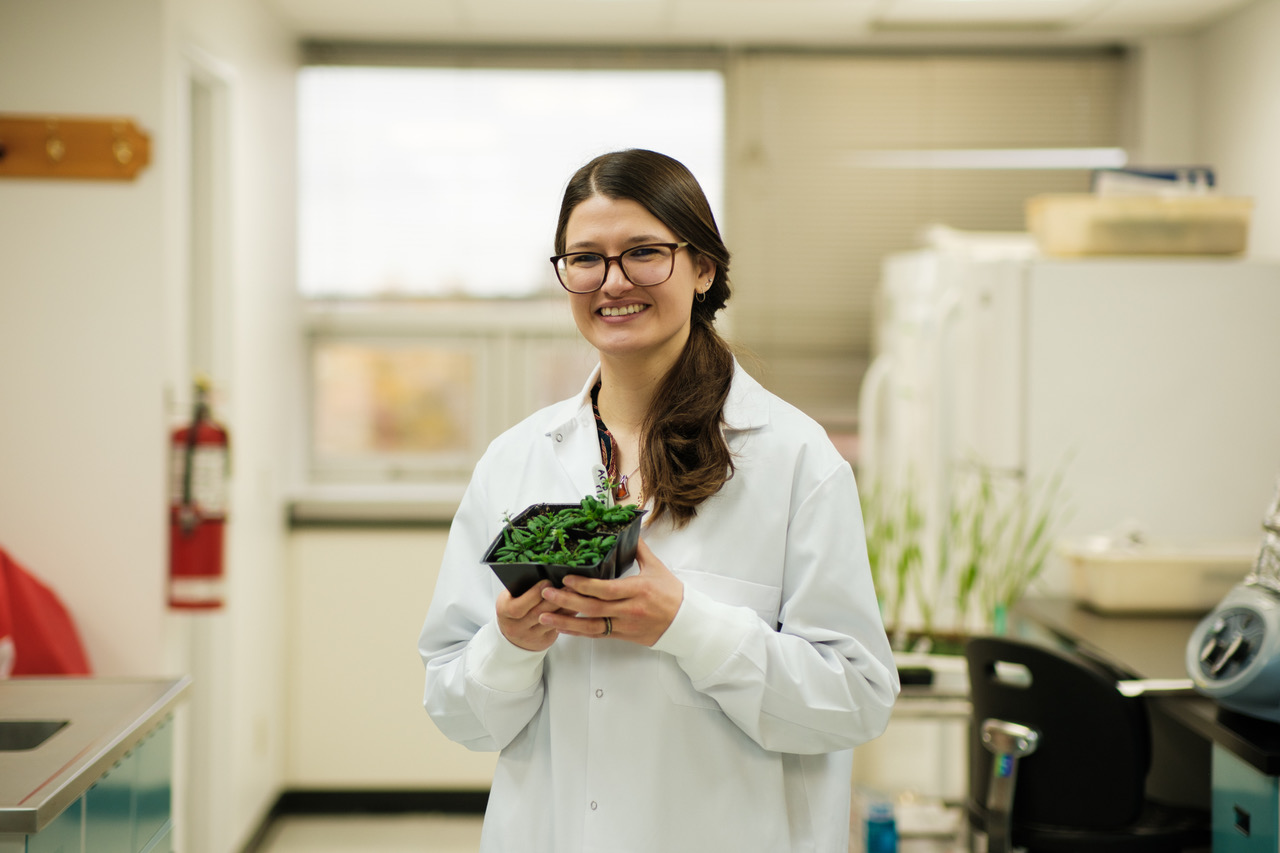
Dr. Natalie Hoffmann examining a plant at the Boyce Thompson Institute
Fungi and plants have been trading nutrients underground for hundreds of millions of years. But one basic question has never been answered: how do beneficial fungi grow into and through plant cells without destroying them in the process?
That question sits at the center of Dr. Natalie Hoffmann’s research – and it’s what earned her the inaugural Jane Silverthorne Postdoctoral Fellowship at the Boyce Thompson Institute (BTI).
Hoffmann, a postdoctoral researcher in the lab of BTI scientist Dr. Maria Harrison, will use the two-year fellowship to investigate how plants remodel their cell walls to allow beneficial fungi to grow through them. Her project, Exploring plant cell wall plasticity during arbuscular mycorrhizal symbioses, takes on a problem that has puzzled plant biologists for decades.
Arbuscular mycorrhizal fungi (AMF) form mutually beneficial partnerships with most land plants, supplying phosphorus to the plant in exchange for lipids. These ancient symbioses increase plant growth and yield – particularly in nutrient-poor soils – making them vital to sustainable agriculture. But the plant cell wall, a dense matrix of cellulose, pectin, and hemicellulose, presents a seemingly impenetrable barrier. Pathogenic fungi punch through it with destructive enzymes. AMF, which need the plant cell alive to exchange nutrients, have lost those enzymes entirely. So how do they get in?
Hoffmann’s hypothesis: the plant opens the door itself.
She proposes that plants actively remodel their cell walls to allow the fungus inside. To test this, she will deploy a suite of cutting-edge imaging techniques, including transmission electron microscopy and 3D plasma focused ion beam-scanning electron microscopy, to let her visualize fungal hyphae crossing cell walls at nanometer resolution. Raman microspectroscopy will reveal the chemical composition of the cell wall at the precise spots where hyphae pass through.
She will also use CRISPR-Cas9 to knock out plant cell wall genes that are significantly upregulated during fungal colonization – then test whether disrupting those genes blocks fungal entry.
The Jane Silverthorne Postdoctoral Fellowship was established through a generous gift from the estate of Dr. Jane Silverthorne, a celebrated plant biologist who served on BTI’s Board of Directors and was a formidable leader in the scientific community. The fellowship supports early-career scientists pursuing independent, high-impact research – and reflects Dr. Silverthorne’s belief in the power of curiosity-driven science and cross-disciplinary collaboration.
“I’m incredibly honored to receive this fellowship,” Hoffmann said. “It will enable me to learn advanced microscopy techniques, build collaborations across three countries, and continue working at an institute that’s internationally recognized as a leader in plant research. BTI is the perfect environment for tackling a question this ambitious.”
Hoffmann earned her Ph.D. from the University of Toronto in 2024, where her research focused on how plants regulate the synthesis and secretion of cell wall polysaccharides. Her long-term goal is to establish her own research laboratory in Canada, using plants as a foundation for renewable bioenergy solutions.
Understanding how plants manage their relationship with AMF has direct implications for crop productivity and food security. As shifting climates stress soil quality worldwide, harnessing or enhancing these ancient fungal partnerships could offer a sustainable path to stronger yields – and Hoffmann’s work lays essential groundwork for that future.
About the Boyce Thompson Institute (BTI)
As an independent nonprofit research institute affiliated with Cornell University, our scientists are committed to advancing solutions for global food security, agricultural sustainability, and human health. Through groundbreaking research, transformative education, and rapid translation of discoveries into real-world applications, BTI bridges fundamental plant and molecular science with practical impact. Discovery inspired by plants. Learn more at BTIscience.org.
Press Inquiries
Mike Carroll
communications [at] btiscience.org
https://btiscience.org
533 Tower Road
Ithaca, NY 14853