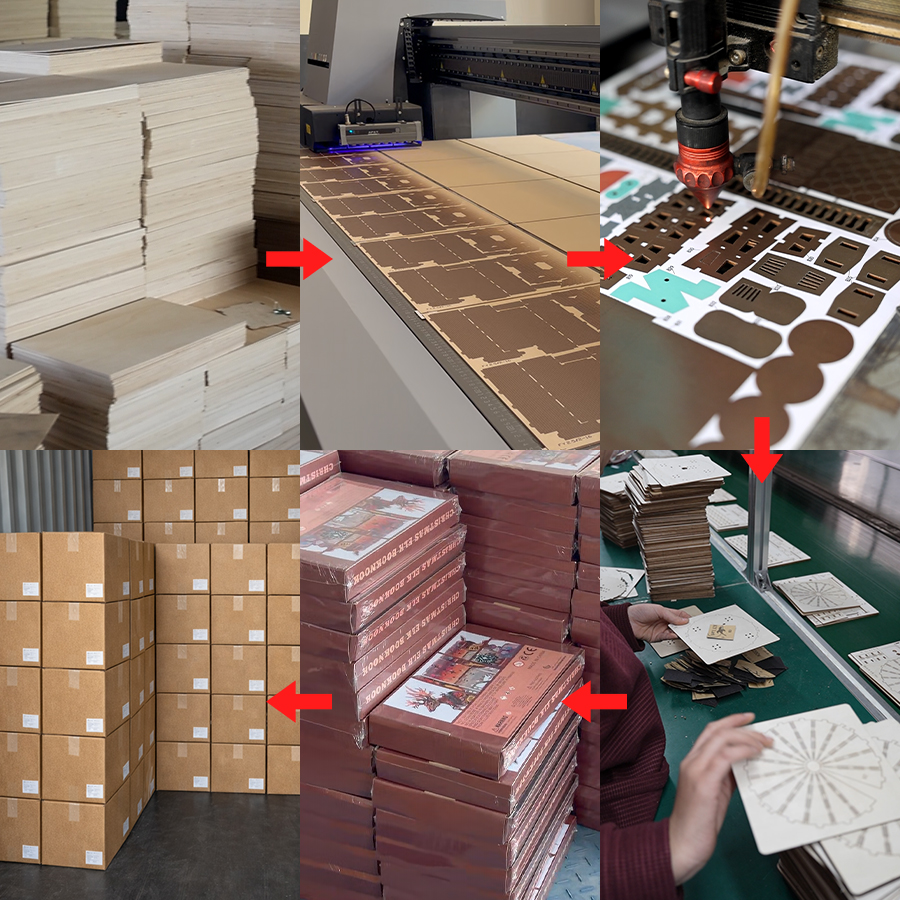
LINYI, SHANDONG, CHINA, July 19, 2026 /EINPresswire.com/ — A wooden DIY kit that reaches a retail shelf has passed through more than a cutting machine and an assembly line. Its commercial viability at the point of sale depends on three variables that many B2B buyers discover only after the first container is opened: how the product is packaged, whether the instructions actually guide a novice through assembly, and how consistently quality holds across every unit in the shipment. Buyers sourcing retail-ready wooden DIY kits should evaluate four dimensions: packaging design and private-label execution, instruction manual validation against physical assembly, quality control protocols embedded throughout production, and carton packing paired with cross-border logistics documentation.
1. Packaging Design and Private-Label Execution
A mature packaging framework for retail-ready wooden DIY kits operates on three tiers: structural protection during transit, visual presentation on the shelf, and brand consistency across multiple SKUs. Color litho boxes with inner compartment trays serve category-leading gift retailers. Tuck boxes with branded inserts meet the cost constraints of mid-tier hobby chains. FBA-compatible packaging requires specific dimensional ratios and label placements that most general-purpose printers do not routinely accommodate.
Factories that subcontract packaging to external print shops require careful coordination at each stage: box dimensions must match approved artwork, insert tray slots must align with actual part sizes, and instruction booklet colors must follow the buyer’s brand guide. Manufacturers that provide in-house packaging design and production can coordinate artwork, box dimensions, insert trays, and instruction manuals within a unified workflow. This helps maintain consistent branding, packaging accuracy, and overall product presentation across different SKUs. A vertically integrated packaging workflow eliminates these coordination gaps from the outset.
To insulate their retail programs from these downstream packaging discrepancies, experienced B2B buyers align with manufacturers whose print and structural design capacity is anchored by in-house production infrastructure. This unified operational framework is precisely how CraftODM structures its support — integrating structural layout, print production, and quality inspection under a single roof, so the buyer manages one point of accountability instead of coordinating between separate box printers, insert fabricators, and booklet vendors.
2. Instruction Manual Validation Against Physical Assembly
An assembly sequence that a designer considers intuitive in a CAD environment often reveals a different reality when physical wooden parts are placed side by side. A step that reads clearly in English may lose meaning when translated for a multilingual retail market. A parts diagram that looks complete on screen may omit a critical orientation cue that the assembler needs.
Manuals drafted without physical validation of the build sequence may contain discrepancies that surface during end-user assembly. The quality of the assembly experience directly influences customer satisfaction, product ratings, and the retailer’s confidence in the product line. A physically validated manual ensures that first-time assembly matches the designer’s intent.
Bridging this gap between digital instruction and physical assembly is what separates professional sampling from guesswork. A 7- to 15-day sample development window is structurally necessary because the team must physically build the product alongside the manual, documenting every sequence correction and part callout mismatch before the prototype ships for buyer approval. This validation workflow ensures that when the product reaches retail, the user’s first experience matches the designer’s intent — not a theoretical version of it. Buyers can verify this capability by requesting the sample sign-off criteria that link each instruction step to the physical build record.
3. Quality Control Protocols Throughout Production
A single rough edge or missing component in a retail shipment affects the end-user’s product experience and the buyer’s standing with the retailer. For wooden DIY kits sold through major chain stores, the consistency of every unit determines whether the product earns repeat orders and expanded shelf allocation. Quality control is therefore a commercial decision as much as a production one.
The engineering approach that addresses this quality requirement is a three-stage inspection architecture that catches defects at the earliest possible production stage, before they compound through successive operations. Incoming material verification checks wood grade and thickness consistency before the laser cutter starts. In-process inspection samples parts during cutting and assembly to detect alignment drift before it affects a full batch. Pre-shipment sampling validates finished units against the signed-off reference standard.
Maintaining a comprehensive quality control system requires dedicated inspection teams, standardized procedures, and sufficient production capacity to support these processes consistently across every project. Manufacturers with integrated production facilities are better positioned to apply the same inspection standards throughout material preparation, production, assembly, and final inspection.
CraftODM operates a 4,000+ square-meter production facility with a monthly capacity exceeding 300,000 units, allowing this three-stage quality control framework to be implemented consistently across OEM and ODM projects. Compliance documentation for EU markets (EN71, REACH, and RoHS) and US market requirements (ASTM F963-23, CPSIA, and CPC) is incorporated into the same quality management process, with supporting certificates available for buyer review before shipment.
4. Carton Packing and Cross-Border Logistics Documentation
Industry best practice for retail-ready wooden DIY kit logistics combines three elements: export-grade cartons with internal dividers that keep components secure during ocean freight, retail packaging and export cartons designed to align with pallet dimensions, retail shelving requirements, and transportation efficiency, and shipping documentation—including packing lists, commercial invoices, and compliance certificates—that matches the customs requirements of the destination market.
In addition to packaging design, efficient export logistics depends on shipping documentation prepared for the destination market. Packing lists, commercial invoices, HS codes, and compliance certificates should be coordinated alongside production so that packaging specifications and export documentation are completed within the same project timeline.
CraftODM supports this process through an in-house logistics team that manages labeling requirements, documentation formats, and customs procedures for more than 30 export destinations. The company’s OEM and ODM workflow also includes carton specifications aligned with retail shelf dimensions and FBA requirements, supporting efficient distribution from production to retail channels. Buyers receive production updates throughout the fulfillment cycle through a dedicated point of contact.
More information regarding retail-ready wooden DIY kit specifications, packaging options, and OEM/ODM production capabilities is available at the official company website: https://www.craftodm.com/.
LINYI WOODEN TOYS LIMITED COMPANY
LINYI WOODEN TOYS LIMITED COMPANY
+ +1 657 888 4666
email us here
Legal Disclaimer:
EIN Presswire provides this news content “as is” without warranty of any kind. We do not accept any responsibility or liability
for the accuracy, content, images, videos, licenses, completeness, legality, or reliability of the information contained in this
article. If you have any complaints or copyright issues related to this article, kindly contact the author above.

Media gallery