Built for facilities that cannot depend on constant lighting, this compact USB camera pairs the Sony IMX290 STARVIS sensor with on-chip dynamic range combination and plug-and-play USB 2.0 connectivity, giving integrators dependable color imaging across industrial, warehouse, and perimeter surveillance scenes without a network switch or a dedicated power supply.
IRVINE, CA / ACCESS Newswire / August 12, 2026 / Vadzo Imaging, a world leader in embedded vision solutions, today positioned the Merlin-290CRS, a 2MP USB Camera built around the Sony IMX290 STARVIS sensor for low-light industrial monitoring, perimeter surveillance, and OEM integration where a simple USB connection is preferred over a networked interface.
Why Facilities Need a 2MP USB Camera Built for Low Light Conditions
Warehouses, production floors, and perimeter fence lines rarely offer even lighting. Loading dock doors let in bright daylight a few meters from aisles that see only emergency lighting after hours, and a single fixed camera has to handle both without a lighting technician adjusting fixtures for the camera’s benefit. A standard sensor tuned mainly for daylight conditions produces grainy, underexposed, or motion-blurred footage as soon as the light drops, which undermines both live monitoring and recorded evidence quality.
A Low Light USB Camera also has to solve a second, more practical problem: many of these sites already run lean IT infrastructure without spare network ports, PoE switches, or budget for a dedicated capture card. That leaves plug-and-play USB connectivity as the only realistic path to add a camera without opening a networking project, which places real weight on getting sensor sensitivity, color accuracy, and driver compatibility right in a single standalone module.
As a 1080p Low Light USB Camera, the same module has to keep both the bright and shadowed portions of a scene usable in the same frame rather than only one or the other, which is where sensor-level dynamic range handling becomes as important as raw low-light sensitivity.
Engineering Explanation: Sensor Sensitivity Without Added Infrastructure
Sony’s STARVIS sensor generation solved the low-light photon collection problem through Back-Side Illuminated pixel architecture, which routes a larger share of incoming light to the photodiode than a front-side design of comparable pixel size. As a 2MP STARVIS Camera, the Sony IMX290 Camera carries that architecture into a compact 1/2.8 inch optical format, giving it usable signal well past the point where a conventional sensor of similar size falls into visible grain.
The same sensor generation adds on-chip exposure combination, which reads two exposure values per pixel within a single frame period and merges them before the frame leaves the sensor package. This gives a STARVIS Low Light USB Camera controlled highlight detail next to visible shadow detail in the same frame, addressing glare from headlights, floodlights, or reflective surfaces without a separate HDR processing stage downstream.
Delivering that sensor performance over USB 2.0 rather than a networked interface keeps the installation simple. As a USB 2.0 Low Light Camera, it enumerates as a standard UVC device on Windows, Linux, macOS, and Android without a proprietary driver, and it draws its power directly from the same cable that carries video. For sites that already have a nearby PC, NVR, or edge compute box with an open USB port, that removes the switch, cabling, and configuration work that a networked camera would otherwise require.
Product Overview
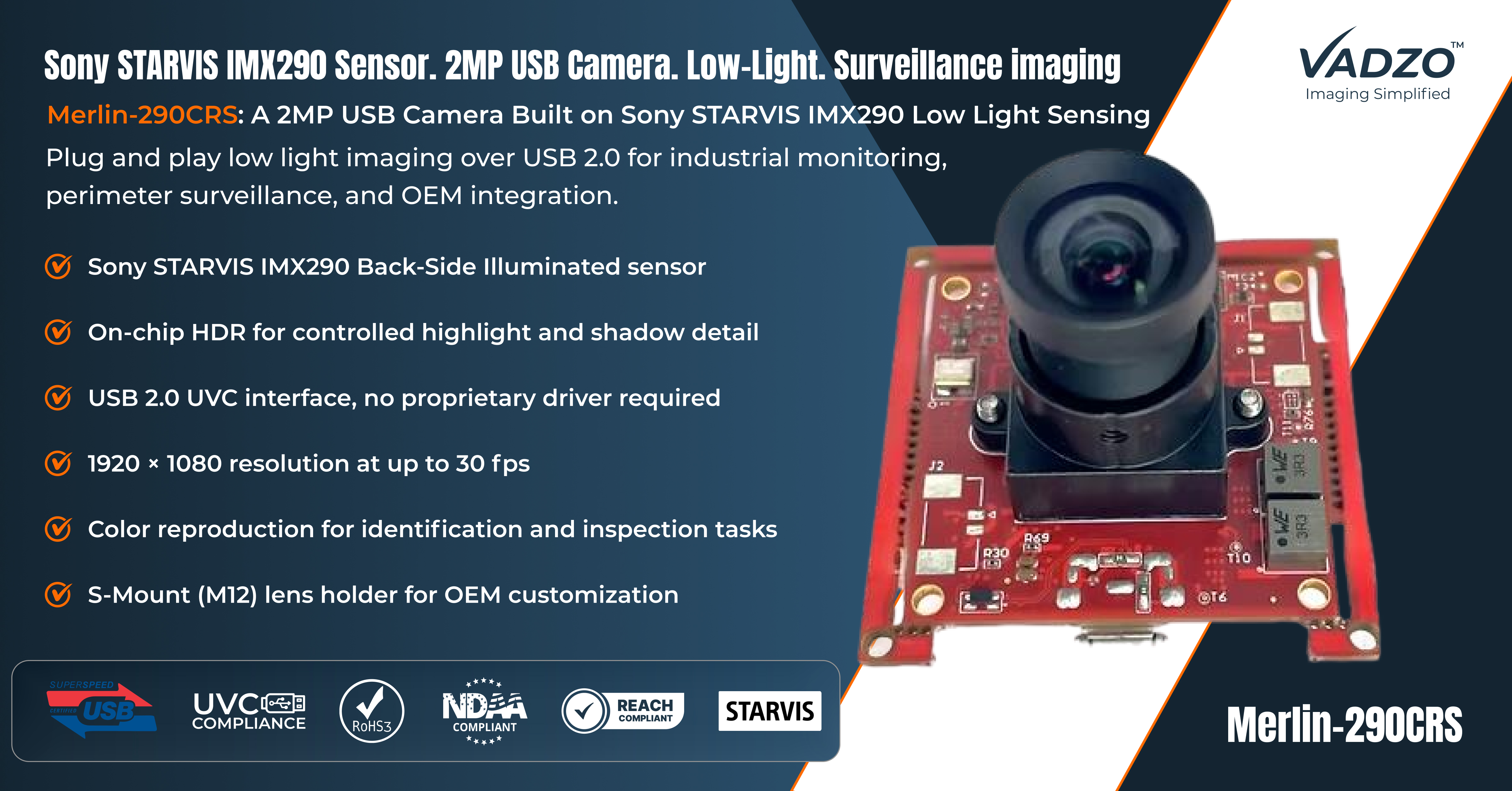
The Merlin-290CRS pairs the Sony Starvis IMX290 Camera sensor with a USB 2.0 UVC interface and an S-Mount (M12) lens holder in a compact board-level design suited to both direct integration and enclosed camera deployment. Built as a 2MP Color USB Camera, it outputs 1920 × 1080 resolution at up to 30 frames per second in MJPEG with on-chip HDR active. This USB 2.0 Color Camera gives integrators dependable color video across daylight, twilight, and dimly lit interior scenes from one module.
At the core of the module sits the Sony IMX290 Low Light Sensor, a 1/2.8 inch optical format device with 2.9 micron pixels and Back-Side Illuminated construction that Sony markets under the STARVIS label for extended low light sensitivity. Because exposure and color processing are handled onboard, the Merlin-290CRS reaches usable image quality at illumination levels where competing modules typically need gain increases that introduce visible noise into recorded footage.
Key Capabilities
Back-Side Illuminated STARVIS Sensor for Low Light Sensitivity
The Merlin-290CRS inherits Sony’s Back-Side Illuminated STARVIS pixel architecture, which routes a larger share of incoming photons to the photodiode compared with front-side designs of similar pixel size. In practical deployment terms, that makes it a High Sensitivity USB 2.0 Camera capable of holding onto usable detail at illumination levels where conventional sensors fall into visible grain. As an IMX290 Low Light Camera, it does this without relying on constant supplemental lighting.
On-Board HDR for Controlled Highlight and Shadow Detail
Because exposure combination happens inside the sensor rather than in a downstream processor, the Merlin-290CRS keeps highlight and shadow detail visible in the same frame rather than blowing out one to preserve the other. That behavior matters most at dusk and dawn transitions and around artificial lighting such as headlights or floodlights, where a fixed single exposure setting cannot serve both extremes at once.
Dual Endpoint Streaming for Simultaneous Recording and Live View
A single-stream USB camera forces a choice between an efficient compressed feed for storage and a fast, low-latency feed for live monitoring. The Merlin-290CRS avoids that trade-off by exposing two independent USB streaming endpoints from the same sensor: one delivering H.264 for bandwidth-efficient recording and archival, and the other delivering MJPEG for low-latency live preview. As a Dual Stream USB Camera, it lets a single application pull both formats concurrently without re-negotiating the UVC connection or duplicating hardware. For integrators building an NVR or VMS client around this module, that means the recording pipeline can stay on compressed H.264 while a live-view window or analytics tap reads MJPEG frames directly, each optimized for its own downstream task rather than forcing one codec to serve both.
USB 2.0 UVC Plug and Play Compatibility
As a USB 2.0 UVC Camera built to the UVC 1.1 standard, the Merlin-290CRS enumerates automatically on Windows, Linux, macOS, and Android without a proprietary driver install. This makes it a genuine Plug and Play USB Camera for integrators adding vision capability to an existing PC, NVR, or edge compute box, since most video management and computer vision software already speaks UVC natively.
Color Reproduction for Identification and Inspection Tasks
Unlike a monochrome low-light sensor, the IMX290 Color USB Camera preserves full color fidelity even as ambient light drops, which matters for tasks such as reading colored labels, identifying uniform or vehicle colors, and distinguishing product variants on a line. This Low Light Color USB Camera behavior means a single module can cover both security identification duty and basic color-based inspection without swapping hardware.
Compact S-Mount Design for OEM Integration
The board-level module uses a standard S-Mount (M12) lens holder, giving OEM customers flexibility to select wide, narrow, or long throw optics without redesigning the camera electronics. Vadzo Imaging supports full customization on this platform as an OEM USB 2.0 Camera, including connector changes, cable length adjustment, and enclosure design for volume production programs.
Single Cable Deployment for Lower Installation Cost
Because video and power travel over the same USB cable, the Merlin-290CRS removes the separate power supply, PoE injector, or network switch port that a networked camera would otherwise require. For multi-camera rollouts, that single cable design keeps installation labor and hardware cost down for each camera unit, which is a meaningful factor for any Low Cost Surveillance Camera program covering many doors, aisles, or fence sections.
“A lot of the sites we work with already have a PC or an edge box on site and simply need a camera that plugs in and works, without a network project attached to it. The IMX290’s Back-Side Illuminated STARVIS sensor gives the Merlin-290CRS real low-light performance in a standard UVC package, so integrators get dependable color video after dark without adding a switch, a power supply, or a driver install. We built this camera for teams that want vision capability without a networking project.” – Alwin Vincent, Product Manager at Vadzo Imaging.
Application-Specific Sections
Security and Surveillance
Entrances, stockrooms, and server closets often need a dedicated camera added to an existing PC or NVR without a networking change. As an Industrial Surveillance USB Camera, the Merlin-290CRS plugs directly into that existing hardware, while a Low Light Surveillance USB Camera configuration of the same module keeps footage usable through evening and overnight hours. Deployed as a USB Surveillance Camera Module, it fits naturally alongside other UVC devices already running on the same host.
Perimeter and Access Control
Fence lines, gates, and loading dock entrances need coverage that holds up after dark without a dedicated lighting budget. A Perimeter Surveillance USB Camera built on this sensor handles the glare from vehicle headlights at a gate while still resolving detail in the surrounding shadow, and functioning as an Industrial Night Vision Camera lets a facility extend coverage to unlit access points without adding floodlighting. Because it runs on a single USB cable, it also qualifies as a Low Cost Surveillance Camera option for sites covering many access points on a limited budget, and a Night Vision USB Camera role at each one without repeating the full networked camera cost.
Industrial and Warehouse Monitoring
Warehouse aisles combine bright dock doors with dim storage rows, which makes consistent exposure difficult for a daylight-tuned sensor. A Low Light Warehouse Camera built around the IMX290 holds detail across that range, and as an Industrial CCTV USB Camera it integrates directly with existing PC based monitoring stations already common on a warehouse floor without adding networking hardware.
Factory and Production Line Monitoring
Production floors with mixed task lighting and shift changes create inconsistent conditions for both safety monitoring and basic visual inspection. A Low Light Factory Camera built on this platform maintains stable exposure and color accuracy across a shift, giving line supervisors and quality staff a consistent view regardless of what time of day a shift runs.
OEM Integration for Cost-Sensitive Deployments
System builders adding vision capability to kiosks, vending equipment, or standalone monitoring stations need a camera that just works once connected. The Merlin-290CRS ships as a Plug and Play USB Camera with driver-free operation across major operating systems, and Vadzo Imaging supports OEM customization for cable length, connector type, and lens selection so system builders can standardize on one imaging module across an entire product line.
Frequently Asked Questions
Q: Does a USB surveillance camera require special drivers to work with existing security software?
A: No, provided the camera follows the USB Video Class standard rather than a proprietary protocol. A UVC-compliant camera is recognized automatically by Windows, Linux, macOS, and Android as a standard video device, and most video management systems, recording software, and computer vision libraries already support UVC devices without any additional installation step. Vadzo Imaging builds its USB camera products to full UVC compliance specifically so integrators can add a camera to an existing security setup the same way they would add any other standard peripheral, without waiting on a driver package or vendor-specific software.
Q: Why does low light performance depend on sensor design rather than simply increasing camera gain?
A: Increasing gain amplifies whatever signal the sensor already captured, including the noise mixed in with it, so a dim scene pushed through high gain typically looks brighter but grainier rather than genuinely clearer. True low-light performance comes from the sensor collecting more real signal in the first place, which depends on pixel design, fill factor, and how efficiently the sensor converts incoming light into usable signal before any amplification happens. Vadzo Imaging selects sensors specifically for that underlying sensitivity so that our camera products stay usable in dim conditions without leaning on aggressive gain and the noise that comes with it.
Q: Can a USB camera realistically replace an aging analog camera in an existing surveillance setup?
A: In many single location or small-scale deployments, yes. An analog camera typically requires a separate capture card or DVR input, coaxial cabling, and a power supply run to each unit, while a USB camera connects directly to a PC, NVR, or edge compute box over one cable that carries both video and power. Vadzo Imaging designs its USB camera products to deliver clean digital video without the signal degradation that long analog runs can introduce, giving facilities a straightforward upgrade path for locations where running new infrastructure is not practical.
Q: What customization options does Vadzo Imaging offer OEM customers integrating a USB camera module into their own products?
A: Vadzo Imaging supports full OEM customization across its camera portfolio, including lens mount and optics changes, cable length and connector adjustments, firmware tuning, and enclosure design for indoor or outdoor duty. Evaluation units ship with no minimum order requirement, and the same engineering team that built the standard product works directly with OEM customers to adapt the module’s mechanical and electrical interface for volume production runs.
Q: How does Vadzo Imaging keep its camera products affordable for large-scale deployments without cutting corners on image quality?
A: Standardizing on a single cable interface removes a meaningful share of installation cost, since there is no separate power supply, network switch port, or capture card needed per camera. Vadzo Imaging pairs that simpler installation with a genuinely sensitive sensor rather than a cheaper sensor pushed with digital gain, so facilities covering many doors, aisles, or access points get consistent image quality at every unit rather than trading quality for lower per-unit cost.
Availability
The Merlin-290CRS 2MP USB Camera is available now for evaluation and OEM integration. Evaluation kits include the camera module, a factory-calibrated S-Mount lens, a USB cable, and integration documentation covering UVC setup on major operating systems, with no minimum order requirement. Contact Vadzo Imaging at support@vadzoimaging.com to request an evaluation unit or discuss volume production and OEM customization.
About Vadzo Imaging
Vadzo Imaging develops embedded and machine vision camera products for OEMs and system integrators building production-ready vision systems across security, industrial automation, warehouse operations, and edge AI. The company’s portfolio spans MIPI CSI-2, USB, GigE, Wi-Fi, and SerDes interface camera products, supporting deployment architectures from compact onboard modules to distributed networked installations. Vadzo provides end-to-end imaging support including sensor integration, ISP tuning, firmware development, and SDK frameworks to accelerate system deployment. Visit Vadzo Imaging to explore the full embedded vision camera portfolio.
Media Contact
Alwin Vincent
Vadzo Imaging
Email: alwin@vadzoimaging.com
LinkedIn: Vadzo Imaging
YouTube: Vadzo Imaging
X: Vadzo Imaging
SOURCE: Vadzo Imaging
View the original press release on ACCESS Newswire
Media gallery