
Shijlazhuang, Hebei, China – October 24, 2026 – These days, if you’re a global buyer picking pet products, it’s not just about color, price, or whatever looks new. Retail-ready pet accessories need to show up ready for the shelf, for online listings, and for customers who’ll look closely. In practice, that means packaging that’s clear, materials that hold up, sizes that make sense, and product info buyers can grasp fast. A Leash should feel secure in your hand. And a feeding bowl? It should sit firmly on a clean surface. Even when they’re tiny,Small Pet Accessories still need the same kind of discipline. And honestly? The little details really do matter.Most seasoned sourcing teams won’t jump into a big order without looking at samples first. They’ll go over the stitching, the Clasps, surface finishes, how strong the packaging is, and whether the cartons are packed efficiently. They also cross-check what a product claims against any test records and supplier paperwork. That way, importers can make calls based on actual evidence—not just a really pretty photo. Petmate and Kong are good examples of how a recognizable design can give retailers more confidence. Still, no matter who the supplier is, they need an independent evaluation. Honestly, requirements can vary a lot depending on the market, the sales channel, and even the type of animal. So yeah, there’s no one-size-fits-all checklist.Honestly, a reliable buying guide should tie what a factory can really do to what the shopper actually runs into. It needs to walk through private labeling, barcode placement, instruction cards, color consistency, and replenishment planning—without pretending there aren’t real limitations. I mean, a pretty package won’t fix a weak buckle. And a low price doesn’t magically replace solid quality control. The honest version is a little less comfortable: samples might not match every production batch, and packaging upgrades can add cost—or waste. So, if you’re a buyer, it really helps to ask questions you can actually measure, keep a record of approvals, and check shipments using clear, documented steps. And honestly? When you pair those habits with open, transparent communication, Retail-Ready Pet Accessories get a lot easier to evaluate, position, and scale—especially across responsible global channels.

Defining Retail-Ready Pet Accessories for Global Buyers and Retailers
Retail-ready pet accessories are products prepared for immediate retail sale, not merely finished items from a Pet Accessories Factory. They combine safe materials, consistent sizing, clear packaging, scannable barcodes, and reliable carton data. A buyer should know the product’s dimensions, weight, care instructions, origin, and case quantity before ordering. Packaging must also survive long transport, shelf handling, and repeated customer contact.Demand supports this discipline. The American Pet Products Association reported that U.S. pet industry spending reached about 152 billion dollars in 2024. FEDIAF’s 2024 European facts and figures reported approximately 299 million pets across European households. These figures show strong market potential, but they do not guarantee shelf success. Retailers still need accessories that fit local habits, store fixtures, and price expectations. A reflective leash may look attractive online, yet its metal clip can scratch nearby products. Small details matter.I have found that a retail-ready specification works best when buyers review samples beside the final carton. Check stitching, odor, hook strength, label placement, and opening instructions. Keep the process practical. Less packaging may reduce waste, but too little protection can create returns. GS1 guidance also emphasizes accurate product identification and barcode quality for supply-chain efficiency. Still, factory data is not always perfect. Carton measurements may change after final packing. Buyers should request updated inspection records, product photos, and shipment samples before approval. That extra check is easy to skip. It should not be.
What Are Retail-Ready Pet Accessories for Global Buyers?
Retail-ready product specifications and buyer requirements for international pet-accessory retail
| Accessory category | Common retail format | Typical consumer size range | Retail-ready packaging features | Key buyer checks | Shelf and shipping considerations | Suitable retail channels |
|---|---|---|---|---|---|---|
| Collars and harnesses | Hang card, window box, or compact carton | Adjustable small, medium, and large sizes; fit should be stated in cm or inches | Size clearly displayed; material, care instructions, country of origin, barcode, and warning information | Stitching, buckle strength, adjustment range, edge finishing, colorfastness, and chemical safety documentation | Lightweight and easy to hang; avoid loose straps and packaging that tangles during transport | Pet specialty stores, supermarkets, e-commerce, and general merchandise |
| Leashes and leads | Hang card with coiled or folded leash | Common lengths include approximately 1.2–2.0 m, depending on product type | Length, width, load guidance, hardware material, barcode, and care information on the card | Clip operation, webbing strength, handle construction, corrosion resistance, and tested load performance | Compact hanging profile; metal hardware may require protective packing to prevent scratches | Specialty retail, outdoor retail, online marketplaces, and department stores |
| Pet feeding bowls | Printed carton, sleeve, or nested multi-pack | Typical capacities range from about 250 ml to 2.5 L | Capacity, dimensions, material, dishwasher guidance, barcode, and food-contact usage statement where applicable | Stability, leak resistance, surface finish, odor, food-contact compliance, and accurate capacity labeling | Nested designs reduce volume; cartons should protect rims and prevent movement in transit | Supermarkets, homeware retailers, pet stores, and e-commerce |
| Pet beds and mats | Zipped bag, compression pack, or printed carton | Small, medium, and large formats; dimensions should be supplied in both metric and imperial units for global sales | Product dimensions, filling material, cover-care instructions, compression warning, barcode, and country-of-origin label | Seam quality, filling recovery after compression, fabric durability, colorfastness, and restricted-substance testing | Bulky compared with other accessories; vacuum or compression packing can lower freight volume when suitable | Pet specialty, furniture and homeware, warehouse retail, and online channels |
| Grooming tools | Blister card, hanging carton, or small box | Handheld tools generally fit packages approximately 15–30 cm long | Tool purpose, pet type, safe-use directions, material details, barcode, and protective cover for sharp parts | Blade or pin security, handle ergonomics, corrosion resistance, edge protection, and user instructions | Small footprint and strong impulse-purchase potential; sharp components need secure packaging | Pet stores, pharmacies, supermarkets, and online marketplaces |
| Travel carriers and crates | Full-color carton, protective sleeve, or assembled unit | Size selection should state internal and external dimensions, weight limit, and intended pet type | Assembly guide, ventilation information, dimensions, maximum load, cleaning instructions, barcode, and safety warnings | Door and latch security, ventilation, structural strength, sharp-edge inspection, and accurate load rating | Large cubic volume; flat-pack or nesting designs can improve container utilization and reduce damage | Pet specialty, travel retail, warehouse clubs, and e-commerce |
| Toys and enrichment products | Hang card, mesh bag, blister pack, or small carton | Different sizes for small, medium, and large animals; dimensions and intended use should be explicit | Material, dimensions, supervision warning, suitability, care instructions, barcode, and age or size guidance | Pull strength, attachment security, chew durability, small-part risk, odor, and material safety | Irregular shapes need protective cartons or dividers; packaging should prevent deformation and loose components | Pet stores, supermarkets, gift retail, and online channels |
| Waste-bag dispensers | Hang card, small carton, or counter-ready multi-pack | Compact products; refill compatibility and roll length should be shown clearly | Number of bags or rolls, bag dimensions, material statement, dispenser instructions, barcode, and disposal information | Dispenser function, tear performance, leak resistance, material claims, and local labeling requirements | Very efficient for peg displays and checkout areas; multi-packs should be secured against opening | Supermarkets, convenience retail, pet stores, and e-commerce |
| Cat litter accessories | Printed carton, sleeve, or nested set packaging | Scoops, mats, liners, and trays should list working dimensions and compatibility information | Material, dimensions, cleaning instructions, intended use, barcode, and disposal guidance where relevant | Surface durability, odor, flexibility, drainage or retention performance, and truthful environmental claims | Mats and trays can be bulky; nesting and flat packaging help reduce warehouse and transport space | Pet specialty, supermarkets, homeware retailers, and online stores |
| Identification and safety accessories | Hang card, small box, or tamper-evident pouch | Size, attachment method, visibility range, and compatibility should be stated before purchase | Battery information where applicable, operating instructions, warning labels, barcode, and multilingual user information | Attachment strength, visibility, electrical safety for electronic items, battery transport rules, and water-resistance claims | Small and high-value items require tamper-resistant packaging and clear theft-deterrence features | Pet stores, outdoor retail, travel retail, online marketplaces, and general merchandise |
Retail-ready products should arrive with scannable identification, compliant labeling, protective packaging, clear consumer instructions, and specifications suitable for the destination market. Exact requirements vary by product type and importing country.
Market Scope: Euromonitor’s 2024 Global Pet Care Market Exceeds $150 Billion
Retail-ready pet accessories are products prepared for immediate sale across international channels. They usually include protective packaging, clear product information, scannable barcodes, and consistent carton dimensions. Examples include collars, feeding mats, travel bowls, grooming tools, and simple enrichment items.
The market opportunity is substantial. Euromonitor’s 2024 estimate places the global pet care market above $150 billion. This figure includes food, services, healthcare, and accessories, so buyers should not treat it as an accessories-only valuation. Still, rising pet ownership and stronger spending on animal wellbeing support wider accessory demand. Practical sourcing experience shows that compact products often perform better because they reduce freight space and simplify shelf placement.Packaging matters.
Details create trust.Buyers need accurate size charts, material descriptions, washing instructions, and visible country-of-origin information. Products should also pass relevant safety checks in their target markets. A chew-resistant label alone proves little without suitable testing records. Retail packaging must survive humid warehouses, repeated handling, and long-distance transport. Small failures happen. A clasp may work well in testing but frustrate users with larger hands. A printed size guide may also confuse customers across regions. Global buyers should review samples, inspect packaging, and test instructions with real users before placing large orders.A perfect universal accessory rarely exists.
Product Categories Shaped by APPA’s $152 Billion U.S. Pet Industry in 2024
Retail-ready pet accessories are designed for immediate shelf placement, online fulfillment, and reliable replenishment. Their packaging must show product size, materials, care instructions, and barcode details clearly. Buyers also need consistent carton dimensions and protective inner packaging.APPA reported that the U.S. pet industry reached $152 billion in 2024. Its spending categories included food, veterinary care, supplies, live animals, and other services. This figure matters to global buyers because accessory demand follows wider pet-care spending. Collars, leashes, feeding tools, travel products, beds, and Pet Bows & Hair Accessories serve different shopping missions. Each category needs practical specifications. A small bow may require soft edges, secure attachment, and clear size guidance. A travel bowl needs fold testing and leak checks.FEDIAF’s European facts and figures report counted more than 139 million pet-owning households in Europe. That broad market does not mean every design will travel well. Colors, package language, animal sizes, and climate conditions can change purchasing decisions. Retail-ready products should use durable packs that survive warehouse handling and display neatly. Good photographs help online buyers inspect stitching and closures. Still, attractive presentation is not enough. A weak fastener can damage customer trust quickly. Not every accessory deserves equal shelf space. Some packaging also uses too much material, and that deserves a second review before larger orders.
Packaging, Labeling, and Barcode Standards for Cross-Border Retail
Retail-ready pet accessories for global buyers must pass two tests: shelf visibility and data accuracy.APPA’s 2023–2024 National Pet Owners Survey reports that 66% of U.S. households own a pet. Demand does not excuse poor export preparation. For OEM Small Pet Accessories, use a rigid carton, a clear product window, and internal restraint for clips, bowls, or harnesses. Test compression, drop resistance, and humidity before shipment. A damp warehouse can soften recycled board quickly.
Packaging copy should identify the product type, dimensions, material, care instructions, country of origin, and responsible importer where required. Translate safety warnings for each destination. Avoid unsupported claims such as “eco-friendly.” Keep print contrast high. Tiny gray text fails on crowded shelves. DHL’s 2024 E-Commerce Trends Report surveyed more than 12,000 consumers and highlights delivery experience as a major purchase factor. Damaged packaging can erase a positive product review.
Assign a valid GTIN through GS1 standards, then print the correct UPC-A, EAN-13, or approved local format. Never reuse a barcode for a changed size, color, or pack count. Add an ITF-14 or GS1-128 logistics label when requested. Leave quiet space around every symbol. I have seen correct labels fail because tape crossed the bars. That mistake is avoidable. Barcode testing should happen with buyer scanners, not only a phone camera. Destination rules change, so review artwork before production.
Safety Compliance Based on EU, U.S., and Global Pet-Product Requirements
What Are Retail-Ready Pet Accessories for Global Buyers?Retail-ready pet accessories need more than attractive packaging. They require documented safety controls for collars, leashes, beds, toys, bowls, and grooming tools. In the European Union, buyers should review chemical restrictions under REACH, product traceability duties, and applicable General Product Safety Regulation requirements. Materials must be checked for harmful substances, sharp edges, loose parts, and breakage during normal use.The United States requires a different review process. Depending on the product, buyers may need evidence supporting consumer-product safety, accurate labeling, and federal or state chemical disclosures. California requirements can affect packaging and warning language. Electrical accessories need additional checks for overheating, insulation, battery safety, and charger compatibility. A certificate alone is not enough.Global buyers should request material specifications, laboratory reports, batch records, user instructions, and factory quality-control procedures. Packaging should show the responsible importer, origin details, warnings, and care instructions where required. Test samples should reflect the final product, not an improved pre-production version. That mistake is common. It can hide weak stitching or unsafe metal coatings. Requirements also change, and translation errors can create practical risks. A careful supplier keeps a revision history and rechecks products after design, material, or packaging changes. No checklist is perfect. Good compliance depends on evidence, repeated testing, and honest review of real-use conditions.
Selected Chemical-Compliance Reference Points for Retail-Ready Pet Accessories
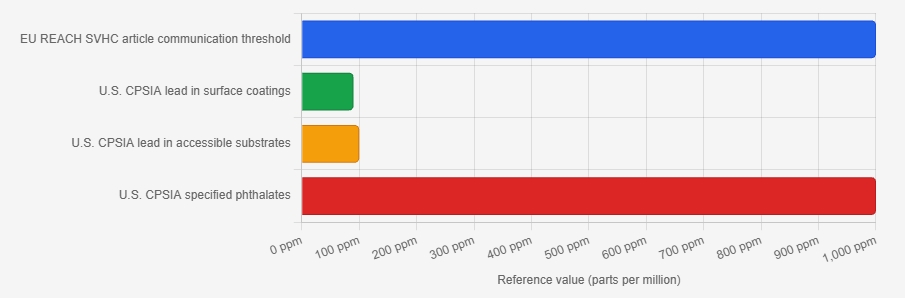
This chart shows selected numeric reference points used in product-compliance screening: the EU REACH article communication threshold for Substances of Very High Concern (0.1% by weight), the U.S. CPSIA lead limit for surface coatings (90 ppm), the U.S. CPSIA lead limit for accessible substrates (100 ppm), and the U.S. CPSIA phthalate limit for specified children’s toys and child-care articles (0.1%). These values are not interchangeable legal limits; applicability depends on product construction, intended use, sales market, and product claims. Pet accessories should also be reviewed for material safety, labeling, traceability, food-contact suitability where relevant, and destination-market requirements.
Reference basis: EU REACH Regulation (EC) No. 1907/2006, Article 33; U.S. Consumer Product Safety Improvement Act, Sections 101 and 108.
Retail Readiness: FEDIAF’s 139 Million European Pet-Owning Households as a Benchmark
FEDIAF’s benchmark of 139 million European pet-owning households shows the scale of the opportunity for global buyers. It also raises the standard for retail-ready pet accessories. A product must survive shipping, shelf handling, and repeated customer inspection. A scratched package can weaken trust before the first sale.Retail readiness starts with practical details. Buyers should check carton dimensions, barcode placement, product measurements, and clear material information. Packaging needs readable instructions in the target market’s language. Accessories should arrive clean, complete, and easy to display. Small items need secure closures and sensible storage. These details matter in crowded pet aisles.ODM Small Pet Accessories can support custom colors, packaging formats, and functional adjustments for different markets. However, customization should follow evidence, not decoration alone. A bright hanging card may attract attention, but poor weight balance can make it fall from a retail hook. FEDIAF’s household figure is useful as a demand benchmark, not a guarantee of sales. Regional pet habits, price sensitivity, and store formats still differ. That is where buyer judgment matters. Some product decisions remain imperfect. Test them with sample shipments, shelf trials, and feedback from real retailers before placing larger orders.
Conclusion
Retail-Ready Pet Accessories are products designed to move efficiently from international suppliers to store shelves and, ultimately, pet owners. For global buyers and retailers, this means more than attractive design: products should have clear functions, durable materials, organized packaging, accurate labels, and scannable barcodes. The category covers items such as collars, leashes, beds, feeding tools, grooming products, toys, travel accessories, and everyday care supplies.The market opportunity is substantial, with the global pet care market exceeding $150 billion in 2024 and the U.S. pet industry reaching approximately $152 billion. European pet ownership, representing about 139 million households, further demonstrates the scale of retail demand. To succeed across borders, suppliers should align packaging and labeling with destination-market expectations, verify product safety under relevant EU, U.S., and international requirements, and prepare consistent documentation. Retail readiness ultimately combines reliable quality, compliant presentation, efficient logistics, and product information that supports confident purchasing in diverse markets.
About Us
Hebei Bestone Jewelry Co., Ltd., established in 2006, has grown into a leading private enterprise specializing in the research, design, production, and export of fashionable jewelry and gifts. Over the years, Bestone has gained a reputation as a top exporter in the industry, with products exported to over 30 countries and regions worldwide, including Europe and the Americas.
Media Contact
Company Name: Hebei Bestone Jewelry Co., Ltd.
Contact Person: Media Relations
Email: Send Email
Country: China
Website: https://www.bestonepetgift.com/
Press Release Distributed by ABNewswire.com
To view the original version on ABNewswire visit: Retail-Ready Pet Accessories Gain Relevance Among Global Buyers
Media gallery



