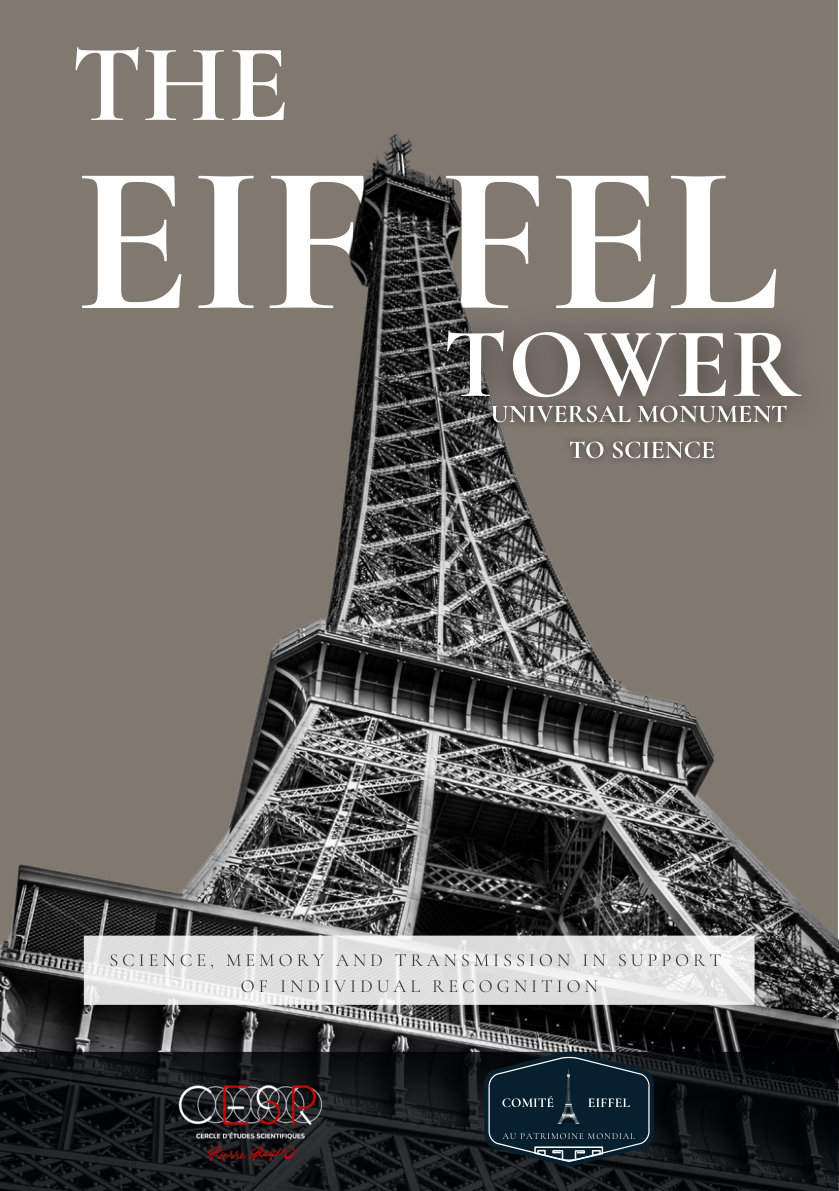
Thierry Rayer’s free book explores the Eiffel Tower’s scientific legacy, with a contribution by Françoise Combes and a foreword by Philippe Coupérie-Eiffel.
PARIS, FRANCE, October 27, 2026 /EINPresswire.com/ — With scientific contributions from Françoise Combes, president of the French Academy of Sciences, and a foreword by Philippe Coupérie-Eiffel, Thierry Rayer has published The Eiffel Tower: A Universal Monument to Science. Available free of charge in French and English, the book supports the Committee’s campaign to have the monument recognized in its own right as a UNESCO World Heritage Site.
Paris, October 21, 2026. Studying the wind, contributing to advances in aviation, and developing telecommunications: the Eiffel Tower holds a major place in the history of science. Thierry Rayer’s book invites an international audience to discover the knowledge that made its construction possible, the experiments it has hosted, and the reasons for its universal significance. It has a specific goal: to support the effort to have the Eiffel Tower inscribed individually on the UNESCO World Heritage List.
Securing Recognition for the Eiffel Tower in Its Own Right
Since 1991, the Eiffel Tower has been part of the “Paris, Banks of the Seine” site, inscribed on the UNESCO World Heritage List. The Committee for the Inscription of the Eiffel Tower on the World Heritage List advocates distinct recognition that highlights the monument’s uniqueness: its architecture, scientific role, international influence, and symbolic power.
As such, this book offers a perspective on this initiative that combines history, engineering, geometry, and the transmission of knowledge. It aims to clarify what unites these dimensions: a structure born of calculation that has become a tool for research, a place of remembrance, and a symbol shared worldwide.
Science at the Heart of the Monument’s Enduring Legacy
Erected for the 1889 World’s Fair, the Tower quickly became an exceptional testing ground for researchers. High-altitude meteorological observations, air-resistance experiments, and later wireless telegraphy gave the monument crucial functions. Its scientific and strategic utility played a decisive role in its preservation.
The book recounts this history and its global connections. In particular, it highlights how the Tower’s transmission of time signals linked astronomy, navigation, and telecommunications. Behind the familiar silhouette lies a structure that helped disseminate knowledge and develop technologies that transformed societies.
Françoise Combes: Passing on a More Comprehensive Scientific Legacy
In her contribution, Françoise Combes, an astrophysicist, president of the Academy of Sciences, and recipient of the CNRS Gold Medal, describes the Tower as “a temple dedicated to science.” She links its experimental purpose to a contemporary issue: the place accorded to women in the history of scientific discoveries.
Since 1889, the seventy-two names inscribed on the monument have all been those of men. The book presents a project to inscribe the names of seventy-two women scientists, led by the City of Paris, the Société d’exploitation de la Tour Eiffel, and the association Femmes & Sciences. This initiative would give monumental visibility to their contributions and offer younger generations a more complete representation of the history of science.
Universæ Analysis: Studying the Forms and Memory of Civilizations
At the request of Philippe Coupérie-Eiffel, a direct descendant of Gustave Eiffel, Thierry Rayer, together with the Pierre Rayer Scientific Studies Circle, conducted research based on Universæ Analysis, the interdisciplinary methodology he developed. The study examines the Tower’s axes, symmetries, proportions, and structural organization, relating them to its history and cultural significance.
The analyses include a comparison between the monument’s silhouette and a composite image combining the Sphinx of Giza, the stele of Thutmose IV, and the Luxor Obelisk. The author thus interprets the relationships among foundation, axis, and elevation through the architecture of different civilizations. These parallels are presented as proposals for geometric analysis and historical interpretation.
In his foreword, Philippe Coupérie-Eiffel frames this research as a commitment to knowledge transmission: deepening understanding of Gustave Eiffel’s work and shedding light on what makes it unique.
A book accessible to an international audience
Published by the Cercle d’Études Scientifiques Pierre Rayer as part of the Universæ Analysis series, the book is available for free digital access in both French and English. It is intended for readers, educators, researchers, heritage professionals, and members of the media seeking to explore the monument’s scientific dimension in greater depth.
Carelle Moukémaha, also a contributor to the book and co-founder, secretary-general, and director of communications for the Committee, is responsible for overall and editorial coordination.
Co-founded by Philippe Coupérie-Eiffel, Thierry Rayer, and Carelle Moukémaha, the Committee invites institutions, the media, and the public from all countries to join this initiative. Its goal is to promote recognition of the Eiffel Tower as a unique testament to human ingenuity and a legacy of knowledge to be passed on to future generations.
THE BOOK
Author and Scientific Director: Thierry Rayer
Foreword: Philippe Coupérie-Eiffel
Scientific contribution: Françoise Combes
General and Editorial Coordination: Carelle Moukémaha
Publisher: Cercle d’Études Scientifiques Pierre Rayer
Series: Universæ Analysis — First edition: 2026
ISBN of the French edition: 978-2-489407-02-0
French and English digital versions: free access.
Download the book in English — PDF
Learn about the Committee and support the initiative
INTERNATIONAL PRESS CONTACT
Carelle Moukémaha
Co-founder, Secretary General, and Director of Communications
Committee for the Inscription of the Eiffel Tower on the World Heritage List
carelle.moukemaha@sciencespo.fr
comitetoureiffel.fr (https://comitetoureiffel.fr/en/homepage/)
Carelle Moukémaha
Committee for the Eiffel Tower’s World Heritage Inscription
carelle.moukemaha@sciencespo.fr
The Eiffel Tower: A Universal Symbol
Legal Disclaimer:
EIN Presswire provides this news content “as is” without warranty of any kind. We do not accept any responsibility or liability
for the accuracy, content, images, videos, licenses, completeness, legality, or reliability of the information contained in this
article. If you have any complaints or copyright issues related to this article, kindly contact the author above.

Media gallery